
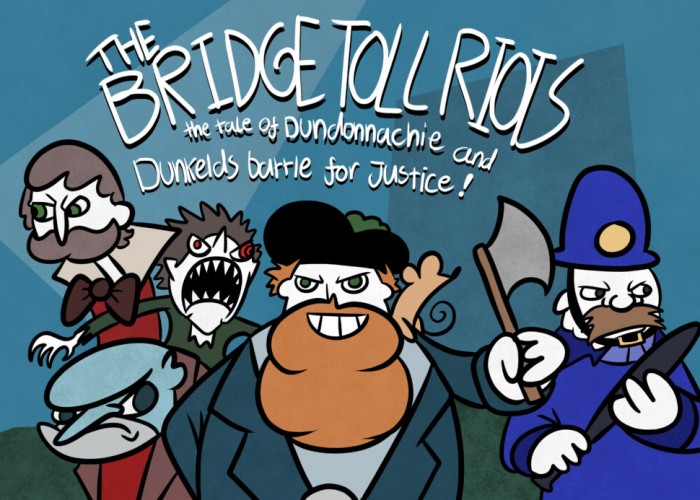
Dundonnachie and the Bridge Toll Riots of 1868
Alexander 'Dundonnachie' Robertson was the rogue instigator of the 1868 Riots.
MoreStruan's what? This is the first question that many of you will be asking. Charr? Isn't that a colloquialism for tea, or the verb for surface scorching a lump of wood? Well neither a cup of tea nor an ugly lump of burnt timber has anything to do with the subject matter in hand. What we are considering is in fact something very beautiful indeed, a living thing and one of the most ancient members of Scotland's wildlife.
This is a fish known more widely as an Arctic charr, Salvelinus alpinus, to give it its appropriate Latin binomial classification. Arctic charr or Alpine charr as they are sometimes known live up to the connotations of their high latitude and altitude name. They are a member of the same family as trout and salmon and like them have their native home in the cooler regions of the northern hemisphere. Indeed Arctic charr extend further north than any other member of the salmon family and in addition they are the only member which has a totally circumpolar distribution.


On of the features of the huge area of distribution of Arctic charr is the divergence of the fish into a large number of local variants, races and sub-species. From Kamchatka all the way round the world to Alaska, scientists studying them are faced with a plethora of physical variation and habitat adaptations which make the finches of Galapagos look like a child's puzzle game. This intellectual challenge is the mother of a fishy fanaticism which transcends all normal scientific objectivity. Scientists studying have indeed become so infected by passion for this incredible animal that they have formed themselves into an organisation called The International Society of Arctic Charr Fanatics (ISAFC). As your current curator at the time of writing, I am pleased to inform you that I represent one third of the Scottish membership. Yet another Clan Donnachaidh connection unfolds.
Many of you are aware that before taking up the post as curator of the museum, I was a fisheries biologist stationed at the Government laboratory at Pitlochry. It was here that my fanaticism for charr began, but it was honed to a fine edge at Loch Rannoch. This was brought about by the discovery, and like all the best scientific discoveries it was an accident, of not one, but two kinds of charr in the loch. Retrieving survey nets, ostensibly set to catch trout, our catch revealed the apparent presence of two distinctly different forms of charr. One form had a large and blunt head, pale body colouration with bright orange fins, no spots and distinct parr banding marks. Later, more detailed analyses confirmed this as a new form to science. The other form was a beautiful, graceful fish of dark claret colouration, pink spots and dark fins. In the case of the males in full spawning condition these fins had strong white edges and the body flanks a brilliant red hue that would make the aniline dyes of the modern Red Robertson tartan look quite anaemic! Striking indeed, but our review of relevant literature revealed this to be no new addition to our faunal list. We had been beaten to the punch by more than a hundred years.

In the Field magazine of October 1881, Sir John Gibson Maitland recounted details of a catch of Loch Rannoch charr netted in September of that year, near to spawning time. The score of fish he netted contained charr he described as: "above the lateral line, black shot with metallic blue and below it, claret coloured, shaded with steel blue; spots salmon coloured." This period was in the great era of Victorian enthusiasm for the discovery of various forms of trout, and charr in British waters had long fascinated scientists. It was definitely a time when the evolutionary 'splitters' were in the ascendancy over the 'lumpers'. Distinct races of charr had also been discovered on Ireland, Wales and the English Lake District. These were often given specific names associated with important people of the time. Thus we have the examples of Gray's Charr and Cole's Charr from Ireland, and Willoughby's Charr from the Lake District. Sir James was of course too modest to name his discovery after himself. He instead chose to name the claret coloured charr in honour of the chief of Clan Donnachaidh in whose ancient territories Loch Rannoch lay. Thus Struan's Charr was bequeathed to science.
Further research has now indicated that Loch Rannoch contains four forms of charr. Three closely related pale forms and the more distinct Struan's Charr. Our Clan Chief's charr has survived the vicissitudes of man and nature for 12,000 years. It has stood the test of time very well, has a distinct 'tartan' of its own and is doing well in a harsh environment. Clan Donnachaidh can be proud of its oldest member!
Alexander 'Dundonnachie' Robertson was the rogue instigator of the 1868 Riots.
More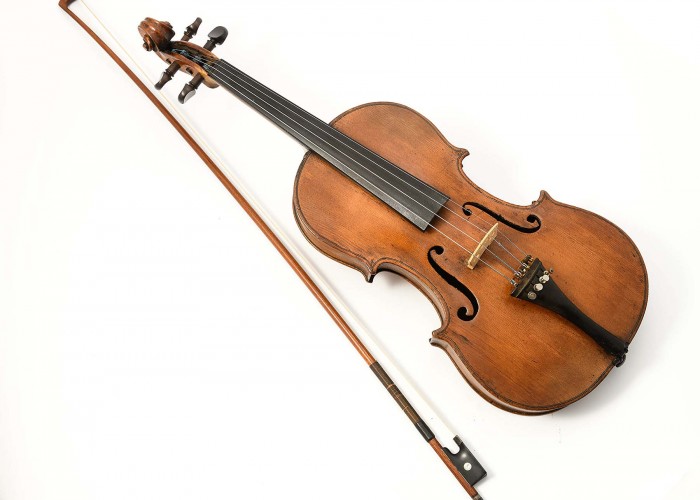
The violin (or fiddle as it is commonly called in Scotland) is an important musical instrument used in Scotland partic
More
The film location of the fictional stone circle called Craigh na Dun, where Claire travels back in time.
More
Clach na Brataich is a legendary stone with historical significance in Scotland and associated with Clan Robertson.
More
James Robertson of the Invervack family was Sheriff of Tobermory on the Island of Mull.
More